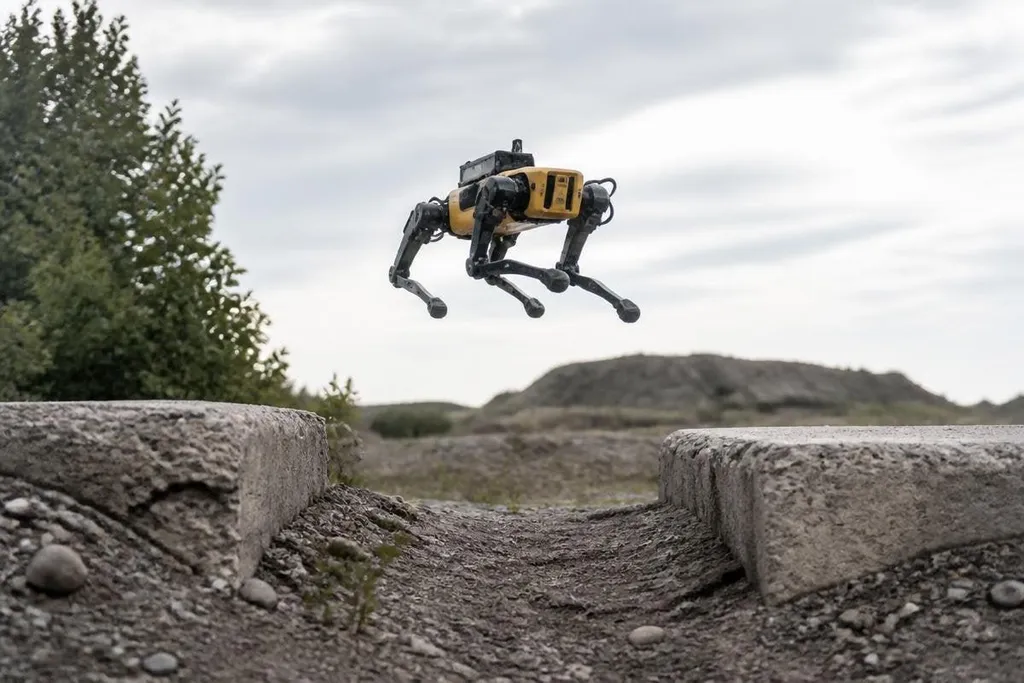
A jumping robot can cross a gap, climb a step, or clear rough ground that would stop a wheeled platform. The trade is simple: it spends stored energy to leave the ground, then must control its body before landing.
- Clear gaps: The robot can move over broken or uneven ground.
- Store energy: Springs, motors, or elastic parts load before takeoff.
- Control the landing: Small errors become large forces when the robot returns to the ground.
Why jumping helps mobility
Wheels need a usable surface. Legs can place a foot on a higher point, but a large gap may still be too wide. A jump removes that contact problem for a short part of the trip.
The robot first pushes against the ground. That force gives its body upward speed, and the robot follows a short flight path until gravity pulls it back down.
The basic height limit comes from takeoff speed: maximum height above takeoff is roughly the square of vertical speed divided by twice the gravitational acceleration, 9.81 m/s².
That equation explains why jumping is costly. Raising takeoff speed increases height, but it also raises the energy needed for the jump and the force absorbed at landing. A robot built for one high jump may need a large motor, a stiff frame, or a spring that can store energy quickly.
The jump is a full-body task
During flight, the robot must control more than its legs. The body can rotate during flight, so the robot may use joint movement, a movable body mass, or a reaction wheel to set its angle before touchdown.
The landing starts before the feet touch. The control system estimates the landing point, moves the legs into position, and spreads the impact across several joints. If the feet arrive at different times, the frame can twist and the robot may fall even when the jump cleared the gap.
This is where legged robots differ from a thrown object. A thrown object follows its path without correcting itself. A jumping robot can change its pose in the air, but that correction needs sensors, fast motors, and enough time before landing.
What jumping adds to field robots
Jumping can help a robot cross rubble, drainage channels, curbs, and broken floors. It may also reduce the need for a long ramp or a carefully prepared route. For inspection work, that could let a machine move through places where wheels lose contact.
The cost appears after the jump. Each landing sends force through the feet, joints, gearboxes, and frame. Repeated jumps can raise wear, drain the battery, and make the robot harder to keep stable on loose ground.
A jump also gives the robot less control over its path than ordinary walking. During flight, it cannot push against the ground to stop or turn in the same way. That limits use near people, fragile equipment, or narrow ledges.
Because a jumping robot spends part of each move off the ground, its landing force and recovery time matter as much as jump height. Robot24 can connect those measures with named machines and reported trials, giving you a way to judge whether a mobility claim fits real use before the next section tests what still lacks proof.
What still needs proof
A lab jump can show that a robot leaves the ground. It doesn't show that the design can repeat the task outside controlled conditions. Useful evidence would include repeated landings, energy use per jump, recovery after a poor touchdown, and performance on surfaces with different grip.
The height of one jump also says little about useful travel. A robot that clears a 20 cm step but needs a long reset after each landing may move more slowly than a robot that climbs the step with its legs.
I'd judge a jumping robot by its recovery rate and energy use, not by its highest leap. The useful question is how many jumps it can complete before charging, repair, or a human reset becomes necessary.
A practical check before choosing one
Use this list when a jumping robot is proposed for a real site:
- Measure the obstacle: Record the gap, step height, landing area, and surface grip.
- Check repeatability: Ask for results from many jumps, not one successful video.
- Price the impact: Include foot, joint, gearbox, and frame wear after repeated landings.
- Count recovery time: Note how long the robot needs before it can walk or jump again.
- Set a safety limit: Keep people and fragile equipment outside the fall and landing zone.
The next useful test is not a taller jump. It is a repeatable route with rough ground, limited battery energy, and a clear record of every failed landing.